You check Lightspeed and it says you have 8 units of a product. You check Shopify and it says 5. Nothing about your day changed — you just happened to look at both screens at once, and now you’re staring at two different numbers for the same item.
This matters because it leads to real problems: a customer buys the last unit in-store, but Shopify still shows one available and sells it online too. Or a customer sees “out of stock” when you actually have five on the shelf. Add in staff time spent double-checking numbers and the confusion multi-location retailers face when Store A and Store B show different counts, and it’s easy to see why this is such a common headache
Inventory differences between Lightspeed Retail and Shopify usually come from one of a handful of causes: product or SKU mismatches, incorrect location mapping, manual changes made in one system but not the other, inventory adjustments like returns or stock counts, other apps writing to the same inventory, synchronization delays, or integration settings that aren’t configured the way you think. Almost all of these are identifiable and fixable once you know where to look.

This issue can occur with both Lightspeed Retail R-Series and X-Series, although the exact synchronization behavior depends on the Lightspeed version, integration method, locations, and configuration.
Why the Two Systems Can Disagree
Lightspeed Retail and Shopify are separate databases. For them to agree on a number, whatever connects them has to correctly match the product, match the location, know which system is the source of truth, and pass along changes reliably. An integration doesn’t make two databases identical automatically. The nine causes below cover where gaps typically show up.
The 9 Causes
Cause 1: Product or SKU Mismatch
What happens: Integrations typically match products between Lightspeed and Shopify using SKU. If the SKUs don’t match exactly, the systems may treat the same item as two different products.
Example: Lightspeed has the SKU TSHIRT-BLACK-M. Shopify has TSHIRT-BLK-M. To a retailer, these clearly represent the same black medium T-shirt, but an integration may treat them as different products if the identifiers don’t match exactly.
Check: Compare the SKU field in both systems character by character, including spacing.
Fix: Standardize the SKU across both platforms and confirm the integration reads the corrected value.
Cause 2: Manual Inventory Changes in Shopify
What happens: Editing inventory directly in Shopify can create a mismatch depending on which system is your source of truth. Lightspeed X-Series documentation recommends Retail POS as the system of record for synced inventory — specific to X-Series’ native integration, not a universal rule.
Example: A staff member manually sets Shopify quantity to 10 while the real, current count in Lightspeed is 7.
Check: Review Shopify’s inventory history for manual adjustments around the time the mismatch appeared.
Fix: Decide which system your team edits directly, and treat the other as read-only for inventory.
Cause 3: Wrong Store or Location Mapped
What happens: Shopify tracks inventory per location; Lightspeed tracks it per outlet. If these aren’t mapped correctly, Shopify can pull the wrong store’s number.
Example: Store A has 12 units, Store B has 0 — but Shopify shows a number that doesn’t match either, depending on how locations are mapped.
Check: Confirm which Lightspeed outlet is mapped to which Shopify location in your integration settings.
Fix: Re-check location mapping any time you open, close, or reorganize a store. Not every configuration supports multi-location behavior the same way.
Cause 4: Inventory Changed Outside the Normal Sales Workflow
What happens: Stock counts, transfers, receiving shipments, and damage write-offs all change inventory — and it’s easy to make one of these changes without it being reflected elsewhere.
Example: A stock count corrects Lightspeed from 20 to 15, but that adjustment isn’t part of regular sync activity.
Check: Ask what happened to the product recently besides a normal sale.
Fix: Check both systems right after any stock count, transfer, or write-off, since these often affect many products at once.
Cause 5: Returns, Refunds, or Exchanges
What happens: Not every integration automatically syncs inventory changes from every type of return, refund, or exchange in both directions. This depends heavily on your setup.
Example: A customer returns an online order in-store. Lightspeed restocks it correctly, but whether that flows back to Shopify depends on your integration’s return handling.
Check: Look at products with recent returns and compare timing to when the mismatch appeared.
Fix: Confirm specifically how your integration handles returns rather than assuming it matches standard sales behavior.
Cause 6: Product Variant Mismatch
What happens: The parent product can look correctly matched while individual variants underneath it aren’t.
Example: A T-shirt has Small (101-S), Medium (101-M), and Large (101-L). If Medium’s SKU doesn’t match between systems, only that size shows the wrong count.
Check: Open each variant individually, not just the parent product, and confirm SKUs match.
Fix: Create matching SKUs at the variant level from the start when adding new products.
Cause 7: Shopify or Another App Changing Inventory
What happens: Fulfillment apps, warehouse tools, or marketplace connectors can also write to the same inventory field your Lightspeed integration manages. This isn’t a Shopify problem — it’s a conflict between multiple systems updating the same number.
Example: A fulfillment app adjusts inventory when it ships an order around the same time your Lightspeed integration updates the same product.
Check: List apps connected to Shopify that touch inventory and see if one modified the affected product recently.
Fix: Limit how many apps are authorized to write to inventory for a given product.
Cause 8: Synchronization Delays
What happens: Syncing doesn’t always mean instant. Large updates, high activity, and Shopify’s own API request limits can delay when a change appears elsewhere. Lightspeed’s documentation notes that Shopify request limits can delay synchronization and that large changes can take time to process.
Example: You update pricing and stock across 200 products at once; some still show old numbers briefly afterward.
Check: Recheck the product a bit later before assuming something is broken.
Fix: Avoid very large batch changes during peak sales hours, and check your integration’s sync log if a delay seems unusual.
Cause 9: Integration or Sync Settings Aren’t Configured Correctly
What happens: Automatic order updates, location mapping, product publishing rules, and system-of-record settings can be configured differently than you assumed.
Example: You assumed all four store locations were connected, but only two were ever set up in the integration.
Check: Review your integration’s settings directly, especially location connections and sync direction.
Fix: Do a full settings review any time you add a location or notice mismatches across many products at once.
Does This Apply to Lightspeed R-Series and X-Series?
Yes. Inventory discrepancies can occur with both Lightspeed Retail R-Series and X-Series when connected to Shopify, but the exact synchronization behavior depends on the Lightspeed version, integration method, location configuration, and synchronization settings. Native Lightspeed functionality and third-party integration platforms may also handle product, inventory, order, and location synchronization differently. If you’re troubleshooting a specific issue, first identify which Lightspeed version you’re using and then check the synchronization rules for that connection.
Quick Way to Find the Problem
| What You’re Seeing | Likely Cause | What to Check |
| Shopify shows more stock than Lightspeed | Delayed or manual update | Recent changes and sync status |
| Only one product is wrong | SKU or variant mismatch | SKU and variant in both systems |
| One store has the wrong quantity | Location mapping | Lightspeed outlet and Shopify location |
| Many products changed at once | Stock count or bulk adjustment | Recent inventory adjustments |
| Inventory changes in Lightspeed but not Shopify | Sync or configuration issue | Integration settings and sync status |
Troubleshooting Checklist
- Pick one product with a mismatch.
- Compare the SKU and variant in both systems.
- Check the inventory location and mapping.
- Review recent sales, returns, transfers, and adjustments.
- Check whether inventory was manually changed.
- Check synchronization status and error logs.
- Test with one product before making bulk changes.
When Automation Makes Sense
Manual management is often enough for a small catalog, low online order volume, or infrequent inventory changes. Automation becomes more useful as inventory changes frequently, in-store and online sales happen together, you carry many SKUs, you run multiple locations, or staff keep reconciling the same mismatches.
How Octopus Bridge Helps Keep Lightspeed and Shopify in Sync
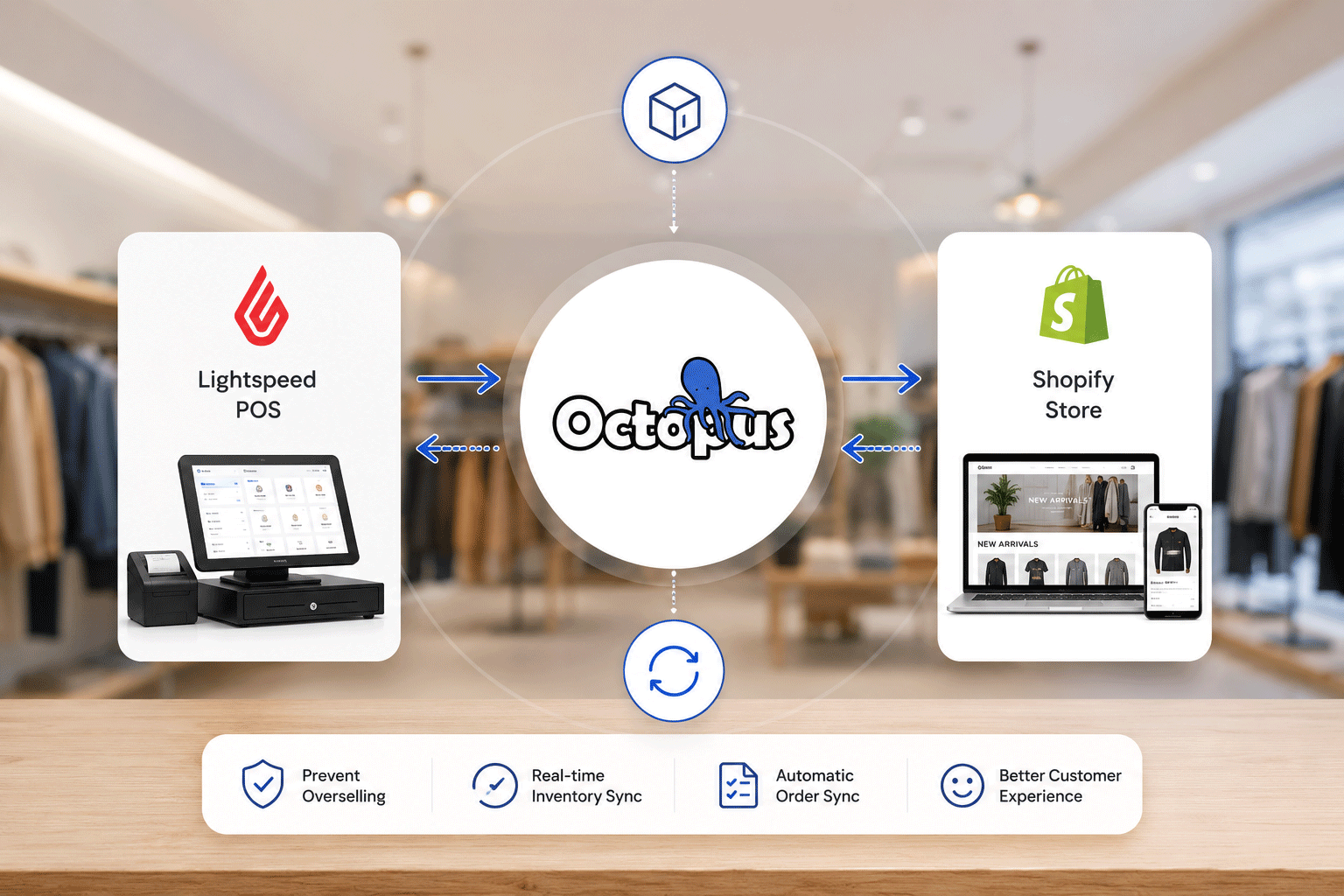
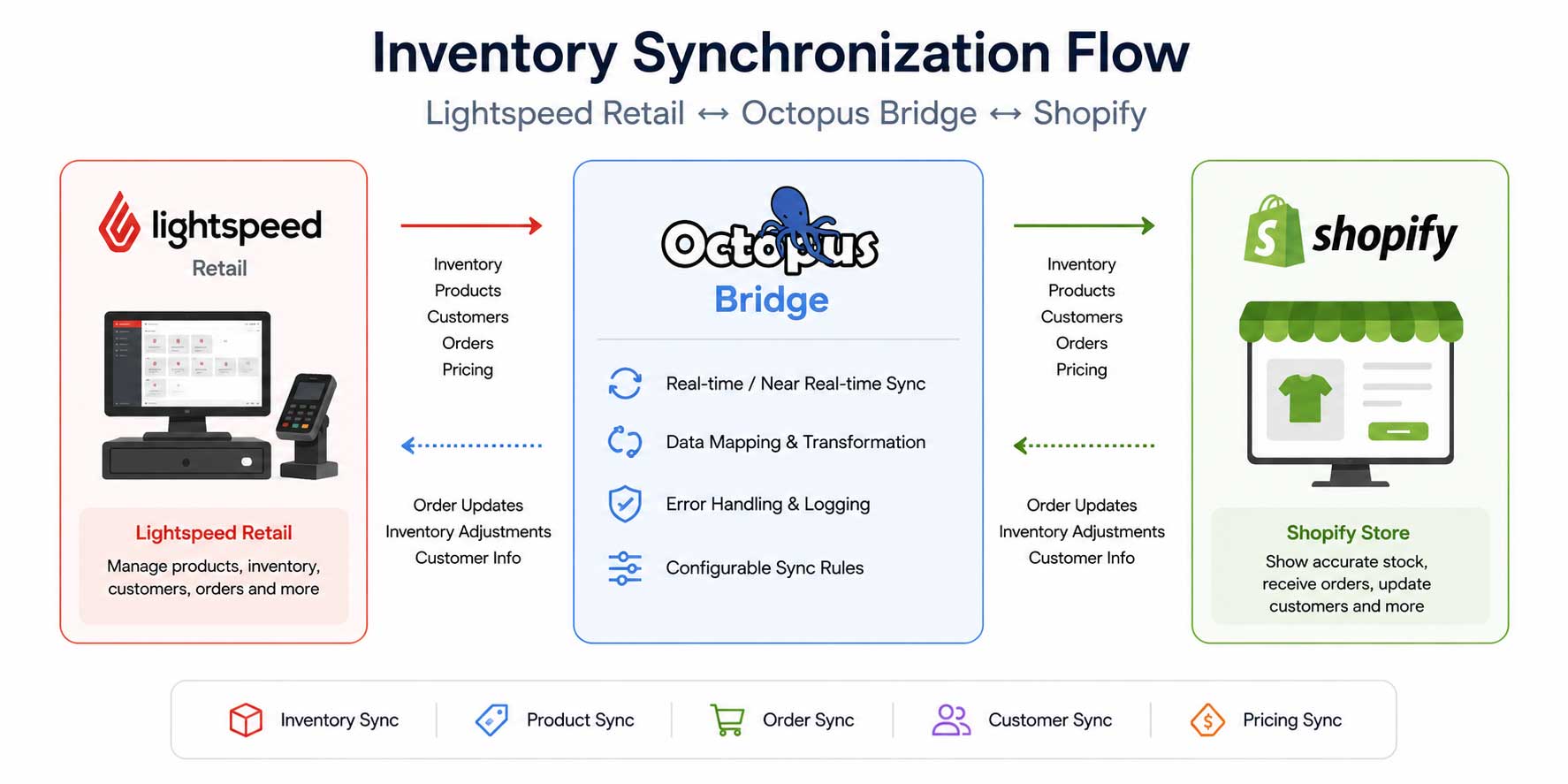
Octopus Bridge is a retail integration platform that connects multiple POS and ecommerce systems, including Lightspeed Retail and Shopify. For retailers running Lightspeed Retail R-Series or X-Series alongside Shopify, it’s designed to reduce the manual work involved in keeping the two systems aligned by synchronizing supported data according to the retailer’s configuration.
Supported areas include inventory, product, order, customer, and pricing synchronization, multi-location support where applicable, flexible sync settings, and near-real-time synchronization where applicable. This doesn’t remove every cause above — SKU mismatches and misconfigured settings still need to be set up correctly regardless of platform — but it reduces ongoing manual reconciliation.
A Usage-Based Option for Smaller Retailers
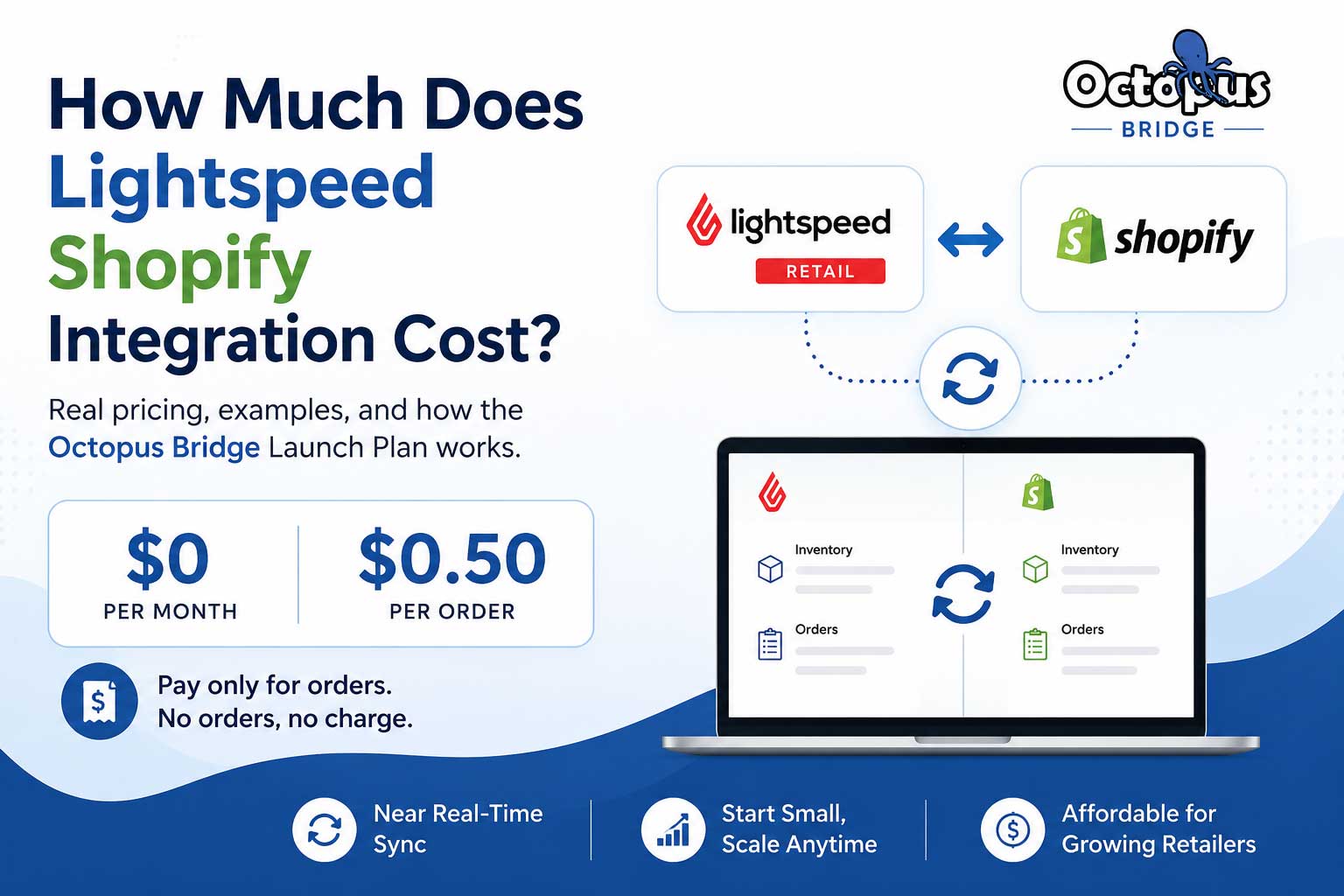
Octopus Bridge’s Lightspeed-Shopify integration starts at $0/month, using a usage-based model — for example, around $0.50 per synchronized order — based on Shopify order volume. No Shopify orders means no usage charge. A retailer processing only 10–30 online orders a month can start without a large fixed monthly fee.
| Situation | Manual Management | Automated Integration |
| In-store sale changes stock | Manual checking/reconciliation may be needed | Supported inventory changes can be synchronized automatically |
| Shopify order arrives | Staff may need to enter/check it in POS | Supported Shopify orders can flow into POS |
| Product changes | Duplicate updates may be required | Supported product data can be synchronized |
| Multiple locations | More reconciliation | Location mapping can automate supported inventory flows |
Retailers evaluating this option can learn more about connecting the two systems through the Lightspeed Shopify integration page.
Preventing Future Inventory Mismatches
- Establish a clear system of record.
- Keep SKUs consistent across systems.
- Map locations carefully.
- Avoid unnecessary manual edits in both systems.
- Review apps that also modify inventory.
- Test one product before bulk changes.
- Monitor sync errors.
- Reconcile periodically.
The Bottom Line
If Lightspeed and Shopify show different inventory, don’t immediately assume the integration is broken. Check product and SKU matching, location mapping, recent inventory movements, manual changes, other apps touching inventory, sync delays, and configuration settings first. As order volume and complexity grow, automated synchronization can cut down the manual reconciliation work, and retailers evaluating that option can learn more about connecting Lightspeed Retail and Shopify with Octopus Bridge.